

“Listening is not the same as hearing and hearing is not the same as listening.”
Pauline Oliveros, Deep Listening: A Composers Sound Practice, 2005
When I first read R. Murray Schafer’s The Soundscape and Bernie Krause’s Wild Soundscapes, I knew then and there that I didn’t have it in me to fully commit myself to acoustic ecology the way I wish I could. You’re telling me I have to get up at 3 in the morning and make my way to a pond to set up my field recording gear to capture the dawn chorus by 4:30 A.M.? You want me to camp in the scary dark woods with a drop rig planted half a mile away at an even deeper and scarier part of the woods so that I can capture a full 12 hours worth of pristine wildlife and psithurism audio without the imposition of human activity? With apologies to my G.O.A.T.s Schafer and Krause, you’re out of your mind if you think this lazyass cityboy has it in him to commit to the field like that.
I jest, but it’s not just the basic inconveniences of traditional acoustic ecology that turn me off, it’s the loneliness above all else. If you know anything about me, you are well aware that I continuously preach the innately social practice embedded in the act of musicking. This is only a surface level observation, however. At the core of music comes the act of listening and sonic awareness that, as demonstrated by Pauline Oliveros’ life's work, is an explicitly social act as much as much as it is a deeply personal and introspective one.
As she explained in a 2012 interview with Art Practical:
"People's experiences are all different, you don't know what the person experienced. They know, but you don't, so I think it's important to listen carefully to what a person has to say. And not to force them into any direction at all but simply to model what you've experienced. Model it and be what I call a Listening Presence. If you're really listening, then some of the barriers can dissolve or change."
I have been an open zealot of the work of Pauline Oliveros and Deep Listening for well over a decade at this point, to the extent that I am now enrolled in the Center for Deep Listening teacher certification program for the Spring 2026 cohort. What I enjoy most about Pauline’s philosophy is that it can be both as spiritually woo-ey and based in a materially musical reality as you’d like it to be. Despite Pauline herself advocating for one to experience Deep Listening in pristine natural environments away from the hustle and bustle of the big cities, the philosophy should not be interpreted as exclusive to rural areas but as a means of listening beyond hearing, and that can happen anywhere.
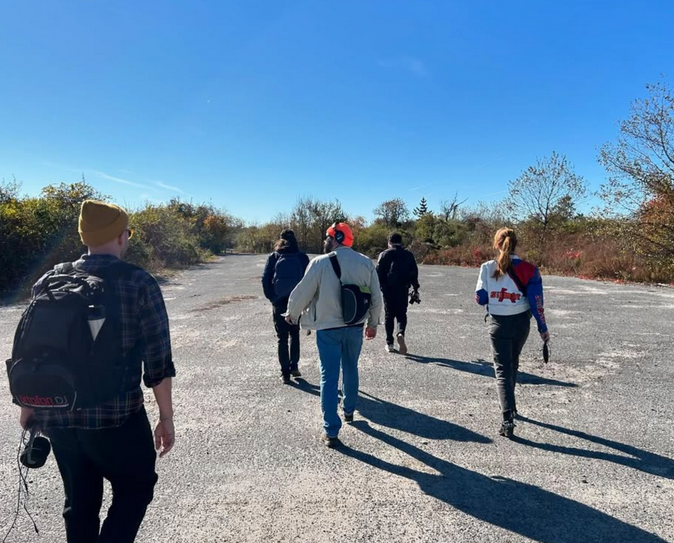
And so it was through this conscious effort to be a Listening Presence and my yearning to listen with others that in the Fall of 2024, I decided to create a workshop series that would be equal parts creative and social in practice. Inspired by many artists who utilize a social practice in public spaces, in particular the work of walking artist Alex Wolfe, I wanted to embark on a series of group outings held at specific locations, all for the sake of then splitting off into trios, pairs, or solos to capture field recordings and discuss our findings amongst like-minded people. I decided on the name Field Recording Field Trips because, despite the seriousness involved in gathering sonic materials out in the field, these outings should still be fun, much like a highly anticipated trip to the planetarium in elementary school.
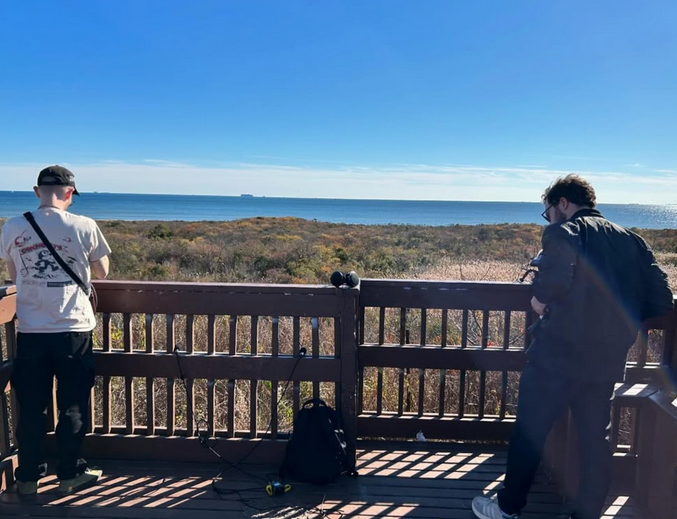
The first FRFT was hosted throughout Brooklyn and Queens on a relatively warm day in early November 2024.
At the time, I was still living in Brooklyn and had been hosting educational programming as part of my time involved at Circular Ruin Studios. For much of that year, my role within the studio team was to host a series of workshops on the topics of audio production, electronic composition, and creative mixing practices. We truly turned a small recording studio in East Williamsburg into an alternative and affordable music technology academy. We held offerings that far outweighed your more traditional and exclusive electroacoustic conservatory experience, if I do say so myself. And this first iteration of the Field Recording Field Trip would be the final educational offering I helped facilitate at Circular Ruin before moving further north.
For this trip, we managed to hire a driver with a Sprinter van so that we could maximize our distance between outer-borough locations. Between myself and workshop co-facilitator Ethan Bourdeau, as well as our driver Will and nine participants, we managed to turn the van into an open forum of discussion between recording sites. As we approached our first stop under the Kosciouszko Bridge on the Newtown Creek between South Queens and North Brooklyn, a consistent talking point was brought up amongst participants:
What the hell are we going to do about all this noise?
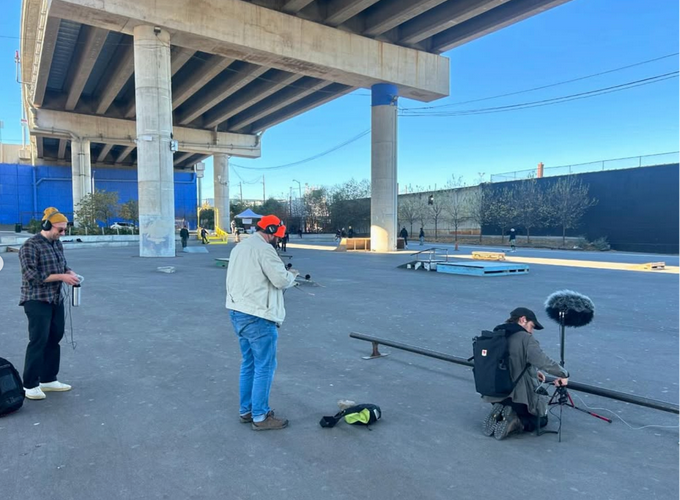
Even within its most “organic” and “untouched” natural environments, New York City is one of the loudest places on earth. Eight-and-a-half million people live within the city alone, and that makes for an inescapable amount of pollution of all kinds regardless of where you are within city limits, and that includes noise pollution. It became apparent to each of us that despite what we saw being a near empty park of refurbished greenery and calm waterfront, what we heard painted a sonic image of industrial klang and abrasive human activity.
To your more traditional acoustic ecologist, our field trip would be destined for failure from the start. What would be the point of seeking some sort of beauty amongst an ocean of pollution? As sonic artists, however, we understand that beauty is in the ear of the beholder. If we are to be surrounded by constant cacophony, we should dive deeper beneath what’s audible to the naked ear and find some aesthetic alignment amongst the garbage. The only way out is through, it’s our job to turn aural lemons into lemonade. As materialists thinking with our ears, we should acknowledge the contradictions in the fact that noise can be both ugly and beautiful, harsh and soothing, polluting yet purifying.
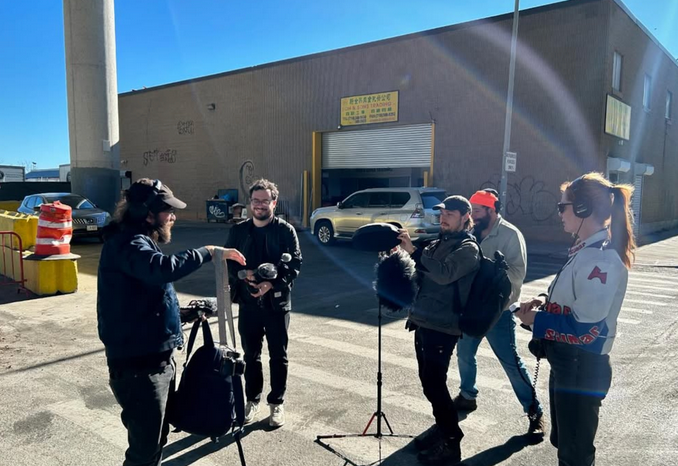
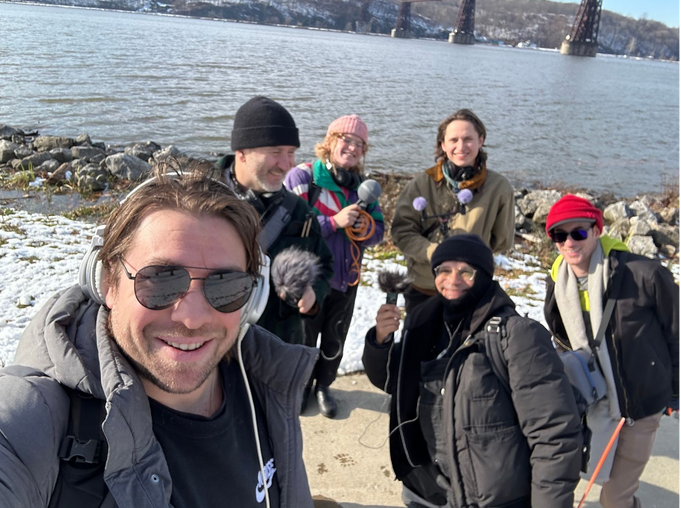
As deep listeners, there’s a power in numbers. Whether it was attaching a contact mic to a rail as local skaters grinded over it, capturing the constant and uniquely humming waves of traffic off in the distance, or the sploosh of toxic water beneath us as we stood by the creek with our mics extended outwards; it became clear that each of us on the trip was attracted to certain sonic corners of the various sites we visited. The act of sharing headphones and seeing our newfound friends’ faces light up when they listened to what their fellow travelers had captured became the ethos of the Field Recording Field Trip. As we continued on our trip towards Fort Tilden in the Rockaways and the Salt Marsh Nature Trail in Marine Park, we became that much more comfortable amongst each other as a group unit. This ethos of a shared experience in seeking out our materialities through noises both large and small continued to blossom until the temperature began to drop and the sun began to set. As we drove back to North Brooklyn under the dark early evening sky, I knew I had to continue these outings wherever I may end up next. The act of listening and recording as a group became a holistic one. We were getting to the core of what Deep Listening truly meant.
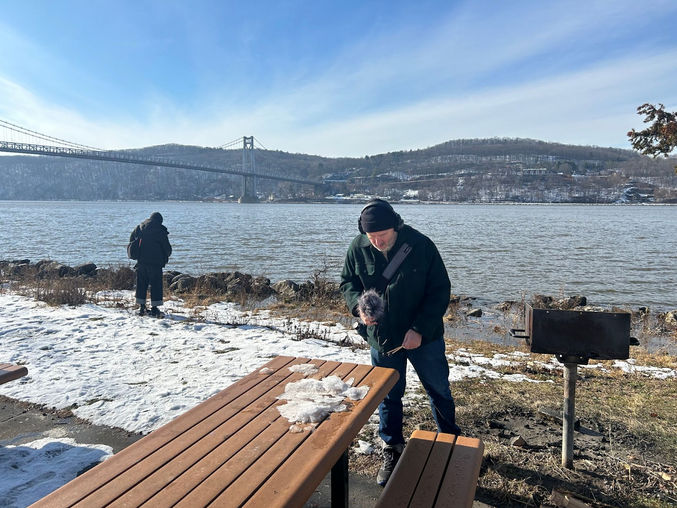
Fast forward one year, and I’m now living in Poughkeepsie, a small and working class city smack dab in the middle of New York’s Hudson Valley region, located about an hour and change outside New York City limits. Here in the Hudson Valley we are surrounded by visual and sonic contradictions. A former boomtown region of early industrialization along the river, now trying to re-invent itself as another “alternative” countercultural hub in the vein of its quieter, greener, and often much wealthier and further gentrified neighboring parts of the valley. To those with ears to listen and eyes to see, the Poughkeepsie waterfront district was the perfect place to host the next iteration of the Field Recording Field Trip series, highlighted by the Walkway Over the Hudson State Historic Park acting as our shining beacon of visual and sonic inspiration 200 feet above the river.
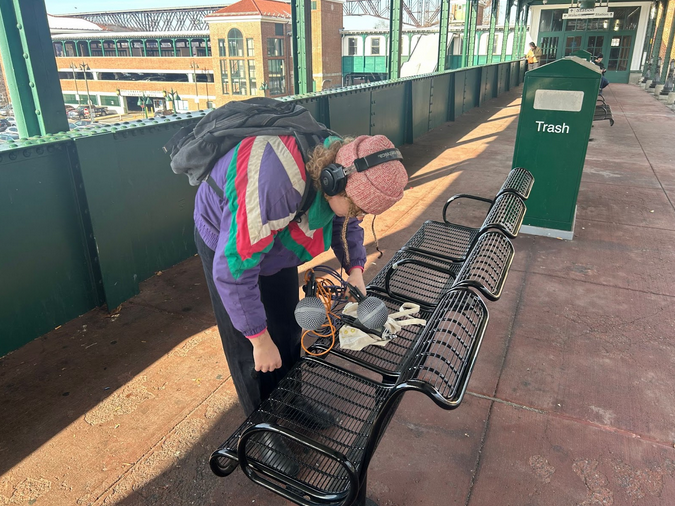
For this edition of the FRFT, I made that much more concerted effort to structure the workshop into three chapters: lecture, field trip, and project critiques.
Rather than strictly using our time together in the field over the course of a single day, we began through an online classroom space, where I introduced the course itself but more importantly its historical context in regards to field recording, deep listening, and tape music as a whole. This in turn became a great way for us to socialize and develop bonds as a group right from the jump. As Pauline perfectly put it:
“Students always learn more from each other than they do from their professor. They learn by doing and not by trying to soak up information from one person."
I set forth a specific assignment for this version of the field trip. Each participant was tasked with creating a compositional framework ahead of time before we met up to go recording, one that didn’t necessarily require a genre specification, but some sort of compositional arc and pre-planned set of tools used to capture the raw materials on the trip. Some participants brought hand held tape recorders, others brought magnetic geophones. Most had some sort of digital recording device, most commonly seen was the Zoom brand of portable recorders. I had also encouraged folks to share these raw materials after the fact as well, even if simply for one’s own personal sample collection to be utilized at a later time.
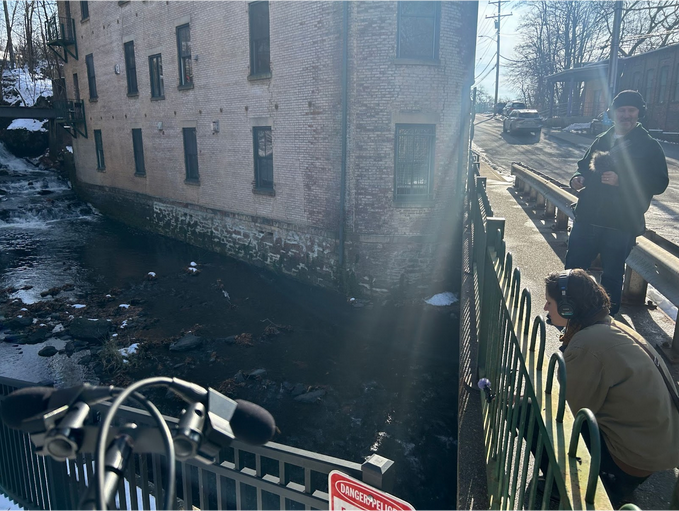
And just like the previous trip, we found ourselves along the Poughkeepsie waterfront and Walkway bridge attracted to different corners of sound. Although quieter than New York City, there’s plenty of noise pollution in the Mid-Hudson Valley. The constant hum of an idling Metronorth train at the railroad station. The foot traffic of tourists and locals alike yapping it up as they took to the Walkway. There was no “perfect” quiet on the Waterfront. We could either find a way to “repair” the noise in post-production by filtering it out, or we could lean into it right then and there and find a way to creatively capture the noise that fits our aesthetic alignments as sonic artists.
For some on the trip, this act of seeking out noise became the crux of their pieces. We quite literally went to find the idling train hum in question and got as close as we could to the engine along the tracks. Up close, the roaring drone became a waveform that was rich in harmonics and lightly wobbling in frequency. We must have looked like crazy people to the cops hanging out in the train station parking lot. A gang of rabblerousers, microphones in hand and headphones over ears, on a mission to discover material sonic truths that we otherwise would have tried our best to ignore.
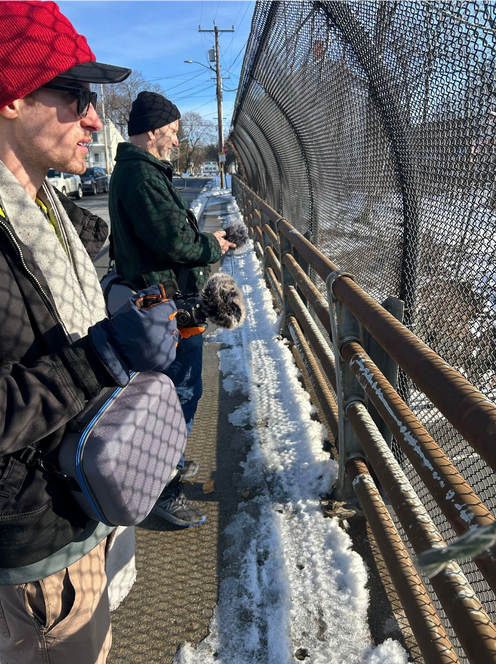
And it was this communal act, absurd as it looked, that encapsulated what Deep Listening is to me. Not simply the act of consciously listening and utilizing various technological tools to enhance the process, but to do so with likeminded folks, strangers, friends, or otherwise. When we met online once again after the field trip to share our recordings and works-in-progress compositions, I made a point to end on this note. Moving forward, these participants don’t need me in order to recreate this experience, in fact I encouraged them all to do it themselves in their own neighborhoods and with their own friends, family, and neighbors. We can all embody the ethos of a Listening Presence wherever we are in the world, and push others to do the same.
The world can be a kinder place and it starts with simple and communal creative acts such as this. Give it a try sometime.
Where to next?